
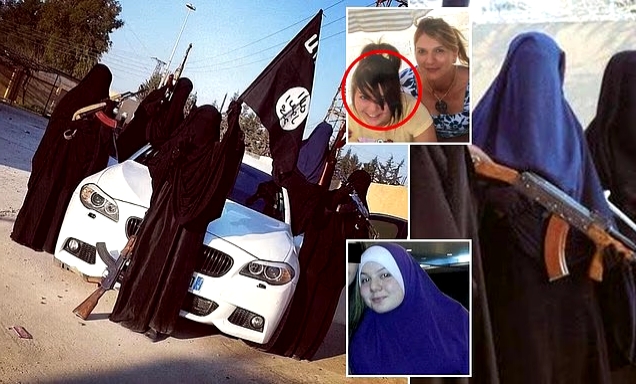
She was the Australian ISIS bride who, from her perch in war-torn Syria, called for mass slaughter in the West: ‘Kill kuffar (infidels) in alleyways, stab them and poison them… Attack: UK, AUS, US’.
And now – after her ‘playboy’ husband was obliterated by an airstrike and she spent years stranded in a refugee camp with her children – Zehra Duman is the face of a growing political controversy surrounding the return of a batch of former ISIS brides.

A one-time Melbourne schoolgirl, Duman, whose precise location is a mystery, is the most notorious of the Australian former ISIS brides who could be either planning to return home or may have quietly returned already.
Authorities confirmed this week that two unnamed women and four children who are Australian citizens had returned to Australia after managing to smuggle themselves out of Syria to Lebanon.
There, they were issued passports after passing security checks.

Aid agency Save the Children has campaigned heavily for the repatriation of Australians from Syrian camps, according to a Senate committee hearing on Wednesday.
There has been intense scrutiny of the Albanese government’s handling of the return of so-called ISIS brides, with Opposition foreign affairs spokeswoman Michaelia Cash calling the Albanese government’s silence on the issue a ‘cover-up’.

Meanwhile, Liberal MP Phillip Thompson warned that ‘allowing ISIS members to return and roam free puts Australians at serious risk’.
Mr Thompson posted a reminder this week of the vicious tweets Duman posted at the height of the conflict of ISIS.

Zehra Duman, originally from Melbourne, encouraged sickening attacks on Australia, the UK and the US – and has spoken of her longing to return home.
After ISIS husband No. 1, Melbourne jihadist Mahmoud Abdullatif, was killed in an airstrike, Duman married two more jihadis who also died.
A Liberal MP has warned about returning ISIS bride Zehra Duman, citing her murderous tweets as her husbands died fighting for Islamic State.

One of Duman’s tweets while she was living in Syria as an ISIS bride is above.
Under the nom de guerre ‘Umm Abdullatif’, she wrote on the platform then known as Twitter: ‘Kill Kuffar (non believer) in alleyways, stab them and poison them. Poison your teachers.
‘Go to haram (forbidden) restaurants and poison the food in large quantities.’

Mr Thompson also quoted Duman rallying for attacks on Britain, the US and Australia when she tweeted: ‘Our husbands die in frontlines but that doesn’t stop women in the west from sending their husbands to kill kuffar. Attack: UK AUS & US’.
Mr Thompson said allowing people like Duman to return to Australia was a ‘reckless move risking the safety of Australians’.

During the conflict, Duman provocatively posted ISIS propaganda pictures of women in burqas waving ISIS flags and holding rifles.
In 2015, Duman sent a threatening message to a Daily Mail reporter after she was contacted for comment.
She said at the time: ‘All you have to know is that the next time I will ever step into Australia, is when we come and make it a part of the Islamic State bi’thnillah(by Allah’s permission).
‘Oh and do I miss my family? Well I think you will miss yours soon (sic). Thank you and have a great day mate!’

Duman is a former student at Isik College Keysborough in Melbourne, who became a notorious online supporter of the Islamic militant group after moving to Syria in 2014 to marry Melbourne jihadist Mahmoud Abdullatif.
Abdullatif, known as the ‘playboy jihadi’, was killed in 2015 and Duman is believed to have married twice more to other ISIS fighters.
With her young son and daughter and a group of about 70 other Australian women and children, Duman ended up in the notorious al-Hawl detention camp in Syria’s north-east, from where she told the ABC she wanted to return to Australia.

‘We did something wrong in the past,’ she admitted. ‘Nobody knows when you come here you can’t really get out. Then you come, your husband dies and there’s no way out.
‘I wanna go back to my country. I’m an Australian citizen. I think I have, not just me but my kids, a right to at least be treated like normal.
‘In Australia … I understand the anger they have towards a lot of us here but the kids don’t need to suffer about this.’