
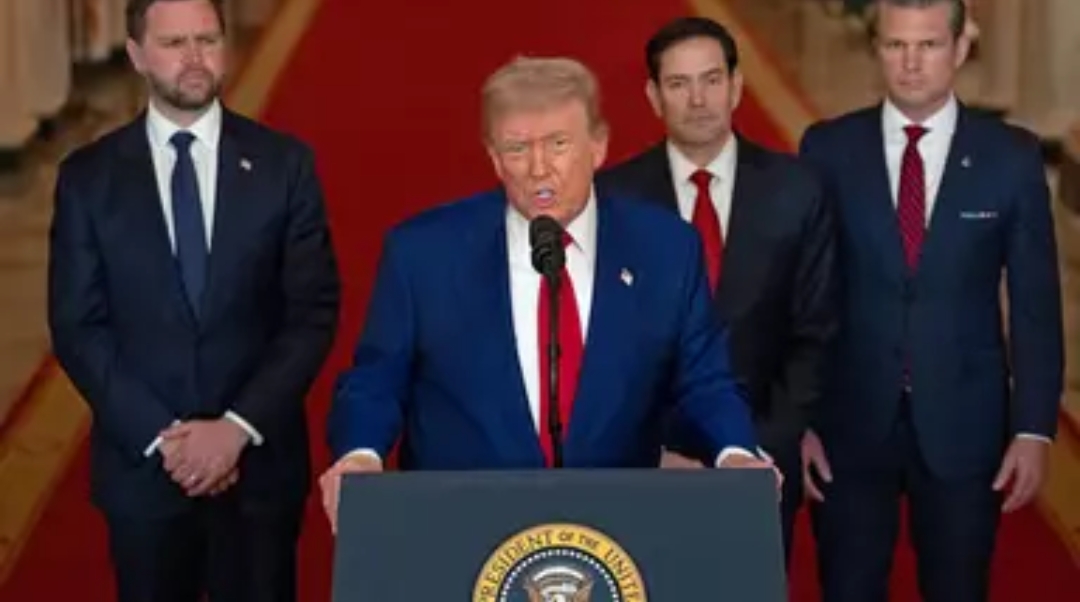
The United States has executed airstrikes targeting three major nuclear facilities in Iran, escalating tensions in the Middle East. The strikes, announced by President Donald Trump on June 21, 2025, hit the Fordow, Natanz, and Esfahan sites, which are central to Iran’s nuclear program. This bold military action has drawn sharp condemnation from Iranian officials, who warn of severe and lasting repercussions.
At 7:50 p.m. Eastern Time, Trump took to Truth Social to declare the operation a “very successful attack.” He described the targeted sites as integral to Iran’s “horribly destructive enterprise” and a threat to global security.
The strikes aimed to dismantle Iran’s nuclear enrichment capabilities, which the U.S. claims fuel the world’s leading state sponsor of terrorism.

In a national address, Trump emphasized the mission’s success, stating, “Iran’s key nuclear enrichment facilities have been completely and totally obliterated.” He urged Iran to pursue peace, warning that failure to do so would invite even more devastating attacks. The President framed the operation as a critical step to neutralize Iran’s nuclear ambitions.
However, the International Atomic Energy Agency (IAEA), the United Nations’ nuclear watchdog, reported no increase in off-site radiation levels at the targeted sites. This suggests the strikes may not have caused the extensive damage Trump claimed. The IAEA stated it would provide further assessments as more details emerge, casting doubt on the operation’s immediate impact.
Iran’s Foreign Minister, Seyed Abbas Araghchi, swiftly condemned the U.S. actions on Twitter, calling them “outrageous” and “lawless.” He warned that the international community should be alarmed by this “extremely dangerous” act, predicting “everlasting consequences” for the U.S. His statement underscored Iran’s resolve to respond to the aggression.
The strikes follow reports of three U.S. stealth bombers departing from American military bases, heading toward Diego Garcia, a strategic U.S.-UK military hub in the Indian Ocean. The movement of these bombers in recent days has fueled speculation about the planning and scale of the operation, with tensions already high in the region.

Iran’s nuclear program has long been a point of contention. The country has been accused of pursuing a nuclear warhead, enriching uranium to 60 percent—far beyond the 3.5 percent needed for civilian nuclear reactors. Natural uranium contains only 0.7 percent uranium-235, which must be enriched by removing uranium-238, a process Iran has advanced significantly.
Enriching uranium to 60 percent brings Iran dangerously close to weapons-grade uranium (WGU), defined as 90 percent purity. This level of enrichment has raised alarms, as it suggests Iran is nearing the capability to produce nuclear weapons, with no clear civilian justification for such high enrichment levels.
According to the Institute for Science and International Security, Iran possesses enough highly enriched uranium to produce nearly a dozen nuclear bombs within a month if enriched to weapons-grade levels. This non-profit watchdog has been closely monitoring Iran’s nuclear activities, highlighting the growing threat.
A June 9 report from the Institute revealed that Iran’s Fordow facility could produce 25 kg of weapons-grade uranium in just two to three days. If both Fordow and the Natanz Fuel Enrichment Plant were utilized, Iran could generate enough material for 11 nuclear weapons in one month, with the potential for 22 by the fifth month.
The strikes come amid heightened regional tensions, with Israel also reportedly bombing Iranian nuclear sites recently. Trump’s actions follow his warnings of severe consequences for Iran’s nuclear advancements, and he has claimed the U.S. now holds “total control” of Iran’s skies, a statement that has sparked debate and skepticism.
The international community remains on edge, with the UN urged to address the escalating conflict. The lack of radiation spikes suggests the strikes may not have fully disrupted Iran’s nuclear infrastructure, raising questions about their long-term effectiveness and the potential for retaliation.
As the situation unfolds, the world watches closely. Iran’s warnings of “everlasting consequences” signal a volatile path ahead, with the risk of further military escalation. The U.S. insists its actions were necessary to curb a global threat, but the fallout—both diplomatic and military—remains uncertain.
This strike marks a pivotal moment in U.S.-Iran relations, with profound implications for global security. As both sides dig in, the international community braces for what could be a defining chapter in the Middle East’s ongoing nuclear saga.