
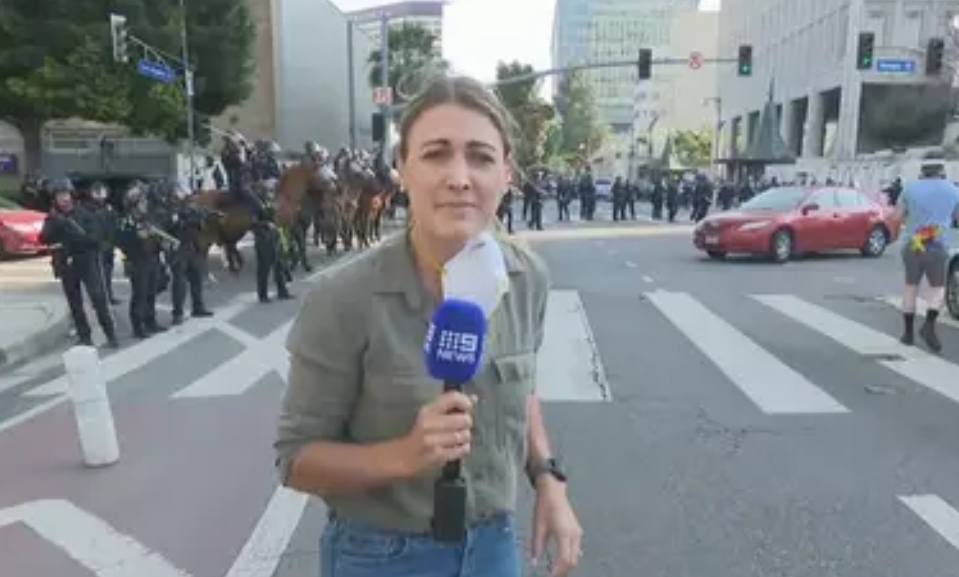
Australian Reporter Shot During Violent LA Riots Sparks Global Outrage
In a harrowing moment captured live on camera, Lauren Tomasi, a correspondent for Australia’s Nine News, was struck by a rubber bullet while reporting on escalating protests in Los Angeles. The incident occurred on Sunday, June 8, 2025, as the city descended into chaos over President Donald Trump’s aggressive immigration policies. The footage, widely shared across social media, has ignited debates about press safety and police conduct during volatile protests, prompting calls for accountability from both Australian and U.S. authorities.
The protests in Los Angeles erupted in response to Trump’s recent immigration crackdown, which included high-profile raids targeting undocumented immigrants. Demonstrators gathered outside the Metropolitan Detention Centre at 257 E Temple Street in downtown LA, where some of those detained were being held. Tensions boiled over as protesters clashed with police, setting fire to cars and engaging in confrontations with law enforcement. The Los Angeles Police Department (LAPD), supported by officers on horseback, responded by firing rubber bullets and deploying other crowd-control measures to disperse the crowd.

Lauren Tomasi was at the heart of the unrest, delivering a live report for Nine News when the situation took a dangerous turn. “After hours of standing off, this situation has now rapidly deteriorated,” she told viewers. “The LAPD is moving in on horseback, firing rubber bullets at protesters, moving them through the heart of LA.” Moments later, a rubber bullet struck her, prompting a bystander to exclaim, “You just f**king shot the reporter!” Despite the shock, Tomasi remained composed, reassuring her team, “I’m good,” when asked if she was okay.
Footage shared by Nine News on social media appears to show an LAPD officer aiming in Tomasi’s direction before firing. The incident, which unfolded in real-time, has raised serious questions about the safety of journalists covering protests and whether law enforcement deliberately targeted the press. Nine News issued a statement confirming the incident, emphasizing that both Tomasi and her camera operator were unharmed and would continue their coverage. “This incident serves as a stark reminder of the inherent dangers journalists can face while reporting from the frontlines of protests, underscoring the importance of their role in providing vital information,” the outlet said.
The protests were part of a broader wave of unrest in Los Angeles, fueled by public outrage over Trump’s immigration policies. Demonstrators accused the administration of inhumane treatment of migrants, with some protests turning violent as tensions escalated. The LAPD had declared an unlawful assembly in the Civic Center area of downtown LA, warning the public to steer clear and advising media to maintain a safe distance from active operations. However, the chaotic nature of the protests made it difficult for journalists to avoid danger while fulfilling their duty to report.
The incident involving Tomasi has drawn international attention, particularly in Australia, where political leaders have condemned the LAPD’s actions. Australian Greens Senator Sarah Hanson-Young described the shooting as “simply shocking” and “completely unacceptable,” calling on Prime Minister Anthony Albanese to demand an urgent explanation from U.S. authorities. “The first thing he must tell the president is to stop shooting at our journalists,” Hanson-Young said. “Freedom of the press is a fundamental pillar of a strong, functioning democracy.” Her remarks underscore the growing concern over the treatment of journalists in volatile environments, where they often face risks from both protesters and law enforcement.
The LAPD’s response to the protests has also come under scrutiny. Prior to the riots, the department’s Central Division issued a warning on X, declaring the Civic Center area an unlawful assembly zone and noting that several arrests had been made. They urged media outlets to keep their distance, a directive that critics argue is difficult to follow when covering fast-moving, unpredictable events. LAPD Chief Jim McDonnell, in a press conference, admitted that the department was “overwhelmed” by the scale of the protests and the actions of some demonstrators. In response to the escalating violence, President Trump called for the deployment of the National Guard, a move that further inflamed tensions.
The shooting of Lauren Tomasi is not an isolated incident. Journalists covering protests worldwide often face significant risks, including physical harm, arrest, and harassment. The use of rubber bullets, while considered a “less lethal” form of crowd control, has been criticized for causing serious injuries, particularly when fired at close range or aimed at vulnerable areas. The Committee to Protect Journalists (CPJ) has repeatedly called for better protections for reporters, emphasizing that press freedom is essential to holding governments and institutions accountable.
In the wake of the incident, Nine News praised Tomasi’s resilience and commitment to her work. The outlet’s statement highlighted the critical role journalists play in documenting events, even in dangerous circumstances. “Lauren and her camera operator are safe and will continue their essential work covering these events,” the statement read. The footage of the shooting has since gone viral, amplifying discussions about the dangers faced by reporters and the need for law enforcement to exercise greater caution when dealing with the press.
The protests in Los Angeles reflect broader tensions in the United States over immigration policy, which has been a contentious issue throughout Trump’s presidency. His administration’s hardline stance, including increased deportations and detention of migrants, has sparked widespread demonstrations across the country. In Los Angeles, a city with a significant immigrant population, these policies have hit particularly hard, fueling anger and mobilization among activists and community members.
As the fallout from the riots continues, questions remain about how the LAPD will address the incident involving Tomasi. Calls for an investigation into the officer’s actions have grown louder, with advocates arguing that targeting a journalist, whether intentional or not, sets a dangerous precedent for press freedom. The incident also highlights the broader challenges of policing large-scale protests, where the line between maintaining public safety and respecting civil liberties can become blurred.
For now, Lauren Tomasi and her team remain on the ground in Los Angeles, continuing to report on the unfolding situation. Their courage in the face of danger serves as a testament to the vital role of journalism in documenting history, even at great personal risk. As the world watches, the incident has sparked a renewed conversation about the need to protect those who bring us the truth, no matter how chaotic or dangerous the circumstances.
The events in Los Angeles are a stark reminder of the challenges facing both journalists and law enforcement in times of civil unrest. While the protests show no signs of abating, the shooting of a reporter has cast a spotlight on the delicate balance between maintaining order and preserving democratic freedoms. As investigations into the incident unfold, the hope is that lessons will be learned to ensure the safety of those who risk their lives to keep the public informed.