
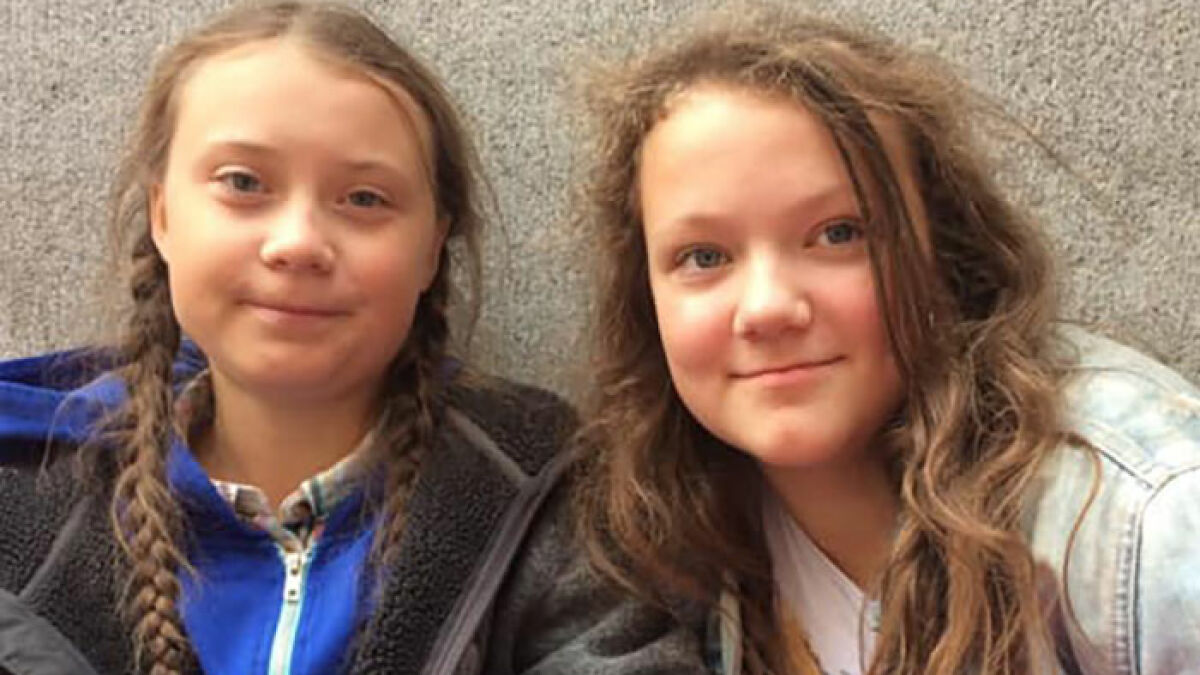
In the midst of global headlines surrounding climate activist Greta Thunberg’s recent detention, her younger sister, Bea Ernman, is carving out her own path in the spotlight. At 19, Bea, once known primarily as Greta’s little sister, is now captivating audiences with her powerful vocals, theatrical performances, and unapologetic style.
Trading the Thunberg surname for her mother’s maiden name, Ernman, Bea appears to be deliberately distancing herself from her sister’s controversial activism to establish her own identity as a rising musical talent.

Bea’s performances are anything but ordinary. Clad in corsets and fishnets, she commands the stage with impressive splits and a fearless energy that has fans and critics buzzing.
Her recent appearance at Stockholm’s Musikaliska showcased her raw talent and emotional depth. In a candid social media post, Bea described her voice as “built from pain,” noting that her performances elicited strong reactions from the audience—some looked “scared,” others “covered their ears.” Yet, she remains undeterred, stating, “I don’t care if people love my artistry or hate it, as long as I make them feel something. Not pity. Love or hate. That’s the point of being an artist.”
Bea’s musical journey is deeply rooted in her family’s artistic legacy. Her mother, Malena Ernman, a renowned mezzo-soprano and former Eurovision contestant, has been a significant influence.

In 2020, the mother-daughter duo starred together in the musical Forever Piaf, with Bea portraying a young Édith Piaf and Malena playing the adult version of the iconic French singer. Reflecting on the experience, Bea told German news agency dpa, “As long as I can remember, I have danced and sung.
To be able to perform [Édith Piaf’s] immortal music is a dream come true.” Malena, in her 2018 memoir Scenes from the Heart, described Bea as the family’s “heroine,” a sentiment echoed in her pride for her daughter’s burgeoning career.
Bea’s rise hasn’t been without challenges. Growing up in the shadow of Greta’s global fame, she faced significant adversity.

In a 2019 interview with Dagens Nyheter, Greta revealed the toll her activism took on her family, particularly Bea, who endured systematic bullying, threats, and harassment. “The one who suffers is my sister,” Greta said at the time. “She has been subjected to systematic bullying, threats, and harassment… The people who write threats and hate to me do it to the whole family, even to her.”
Unlike Greta, who was often on the move, Bea remained more vulnerable at home, making her an easier target for detractors.

Despite these hardships, Bea has channeled her experiences into her art. Her social media presence, under the handle @beatamonalisa, is a vibrant showcase of her performances, where she belts out powerful notes and shares glimpses of her creative process.
In 2019, she released her single Bara du vill (Only if you want) on Spotify, earning praise from Greta, who called her “super talented” in a supportive post. The sisters’ bond, though tested by public scrutiny, remains evident in these moments of mutual admiration.

The Ernman-Thunberg family is no stranger to public attention. Malena’s 2020 memoir Our House Is On Fire offered insight into their neurodivergent household, with both Bea and Greta diagnosed with Asperger’s syndrome and Malena and Bea with ADHD.
Malena described her daughters’ neurodivergence as a “superpower,” emphasizing their out-of-the-box thinking as a strength that fuels their creativity and resilience. “Autism and ADHD are not handicaps per se,” she wrote. “In many cases, they can be a superpower, that out-of-the-box thinking you so often hear performers, artists, and celebrities talk about.”

Public reactions to Bea’s emergence as a performer have been mixed. Some online commentators have praised her boldness and talent, while others have been critical, with remarks ranging from accusations of exploitation to skepticism about the environmental impact of her music career.
One commenter noted, “Bea looks happy or traumatized depending on how you see it,” while another quipped, “The irony of her sister wanting to break the music industry… which I’m sure she doesn’t have the money to do in an environmentally friendly way!” Such polarized responses highlight the challenges Bea faces in stepping out from her sister’s shadow.

Greta’s recent detention, which occurred while she was delivering aid on a ship in international waters, has once again thrust the Thunberg name into the global spotlight. Yet, Bea remains focused on her craft, continuing to share performance videos and engage with her growing fanbase.
Her decision to adopt her mother’s maiden name, Ernman, signals a deliberate move to forge her own identity, separate from the weight of her sister’s activism.

As Bea continues to build her career, her story is one of resilience and reinvention. From enduring the fallout of her sister’s fame to commanding stages with her powerhouse vocals, she is proving that she is more than just “Greta’s little sister.”
With her mother’s guidance and her own fierce determination, Bea Ernman is writing her own chapter, one bold performance at a time. As she navigates the complexities of public life, her journey serves as a reminder that even in the shadow of a global icon, there’s room to shine.