
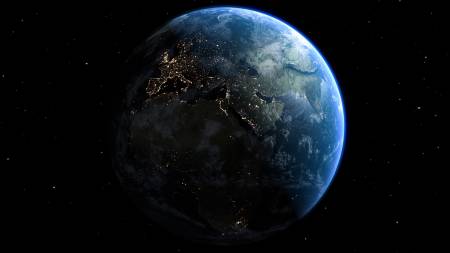
NASA has dropped a bombshell that’s sending shivers down the spine of humanity: Earth is slowly running out of oxygen. A groundbreaking study, backed by the space agency, hints at a future where life as we know it could cease to exist. But when will this happen, and how much time do we really have?
Doomsday predictions are nothing new. From AI overlords to whispers of World War 3, the world has been bombarded with apocalyptic warnings. Yet, this latest revelation from NASA feels different—more primal, more inescapable. It’s not about machines or wars; it’s about the very air we breathe.
The study, supported by NASA’s Astrobiology program, paints a grim picture. Earth’s oxygen-rich atmosphere, the invisible shield that sustains life, may not be as permanent as we thought. Scientists are now questioning whether our planet can keep supporting us for as long as we assumed.
What makes this warning even more unsettling is the political backdrop. The Trump administration’s earlier plans to cut funding for space research, including missions tracking greenhouse gas impacts, have left some wondering if we’re ignoring the signs of our planet’s decline. Could these decisions hasten our fate?

The research, a collaboration between NASA and Japan’s Toho University, dives into the mechanics of Earth’s atmosphere. As the Sun grows hotter over millions of years, its rising solar radiation will disrupt the delicate balance of gases we depend on. The countdown to catastrophe has already begun—but how soon will it hit?
In about a billion years, oxygen levels could plummet to less than 10% of what we have now, the study warns. But here’s the twist: the descent into a “great deoxygenation” might start much earlier—perhaps in just 10,000 years. “The lifespan of oxygen-rich atmospheres may be shorter than we thought,” said Christopher Reinhard, co-author from the Georgia Institute of Technology.
Rising temperatures will accelerate the breakdown of carbon dioxide, a gas plants need for photosynthesis. As CO₂ levels drop, plants will wither, unable to produce the oxygen that fuels life. The domino effect is chilling: no plants, no oxygen, no survival for humans or animals.
As oxygen vanishes, the ozone layer will collapse, leaving Earth exposed to the Sun’s brutal ultraviolet rays. Lead researcher Kazumi Ozaki warns of a future atmosphere choked with methane, nearly devoid of CO₂, and stripped of protection. The planet would become a hostile wasteland, habitable only by anaerobic microbes.
Eerily, Earth has been here before. Billions of years ago, before the Great Oxidation Event, our planet’s atmosphere was similarly oxygen-starved, incapable of supporting complex life. Are we doomed to return to that barren state, or can we change our trajectory?
The good news—if you can call it that—is time. Scientists estimate the final collapse won’t happen for a billion years, with the earliest signs of decline possibly appearing 10,000 years from now. That’s roughly 400 generations away, a distant horizon for humanity to grapple with.
Still, NASA’s warning lingers like a shadow. The air we take for granted, the invisible force that keeps us alive, isn’t guaranteed forever. As the Sun grows fiercer and our atmosphere falters, the question looms: can we outsmart the ticking clock of Earth’s oxygen crisis?